


Thermal-Desorber system specification
Specification of system's main units
| Feeding system | Live bottom feeder with two screws. Transporting screw conveyor and injecting screw conveyor. |
|---|---|
| Holo-Scru Dryer | The dryer chamber includes twin, intermeshed HOLO-SCRU® rotors. The dehydrating heat is indirect. Thermal fluid is circulated throughout the HOLO-SCRU® rotor and outer jacket of the drying chamber. |
| Water Side Closed Loop Condenser/Scrubber | The condenser system provides the continuous removal of moisture evaporating from the solids. The process captures particulate and condenses the evaporated water. |
| ELECTRIC-SCRU® Electrically heated, indirect screw processor | The “Electric-Scru” Processor is a continuous heater/dryer specifically designed for thermal desorption applications. |
| Oil Side Closed Loop Condenser/Scrubber | A high efficiency, direct contact, multi stage Venturi type condenser. |
| Thermal Fluid Heater | The heating can be accomplished with a variety of energy sources including; waste heat, solar thermal, bio-gas, natural gas, propane, #2 fuel oil, diesel, coal, or electricity. |
| Cooling screw | The water-cooled screw rotor and jacketed housing combine to cool the dried biosolids for safe handling. |
| PLC | Control system with graphic UI to monitor ant control system operation. |
Feeding system
Feed system includes a feed containment bin (hopper) with internal twin intermeshed mixer arms which shall inhibit bridging and push the sludge onto a live bottom in the hopper. The live bottom shall provide feed to a feed screw conveyor for a metered discharge.
^ TopHolo-Scru Dryer
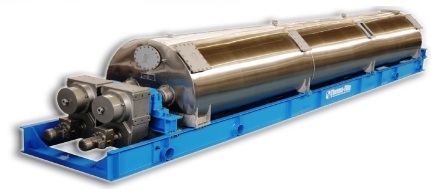
The dryer chamber includes twin, intermeshed HOLO-SCRU® rotors. In the drying chamber, biosolids are heated under slight negative pressure in a sealed, anaerobic environment. The dehydrating heat is indirect. Thermal fluid is circulated throughout the HOLO-SCRU® rotor and outer jacket of the drying chamber.
The BIO-SCRU® continuously produces 90%+ dry product with a variety of sludge consistencies due to three primary control factors. With the ability to control the feed rate into the dryer, the residence time in the dryer and the temperature of the dryer, the IC-Series BIO-SCRU® continually produces a dry product of consistent solids content.
The heat energy for drying, is indirect, thermal fluid is circulated through the rotor, fliting and the outer jacket of the drying chamber, in a closed loop path. The drying process operates under a slight negative pressure in a sealed chamber. Feed is extruded into the dryer from the feed hopper. A lock box and cooling screw maintain the seal at the discharge. A integrated scrubber/condenser removes the vaporized water from the system and captures any particulate.
^ TopWater Side Closed Loop Condenser/Scrubber
A high efficiency, direct contact, multi stage Venturi type condenser, constructed of corrosive resistant materials, followed by a packing section scrubber to remove airborne particulate. The scrubber is very effective at condensing steam and removing particulate, odors and fumes. The design of the scrubber allows for collapsing of the steam and removal of particulate by impacting the gas stream with a high velocity spray of scrubbing/condensing liquid. After contacting the gas the scrubbing/condensing liquid and the entrained condensate is distributed through packing material then enters the lower chamber of the condenser. Condensate will then be pumped through a filter and cooled in a heat exchanger for reuse as the condensing medium. The heat exchanger cooling water side with need to be cooled via a cooling tower, cooling water pond, or other such method so as to provide cooled water to the heat exchanger.
Thermal Fluid Heater
The thermal oil heater uses PLC control for optimal heating efficiency. The heating can be accomplished with a variety of energy sources including; waste heat, solar thermal, bio-gas, natural gas, propane, #2 fuel oil, diesel, coal, or electricity.
^ TopElectric-Scru Thermal Desorption Unit
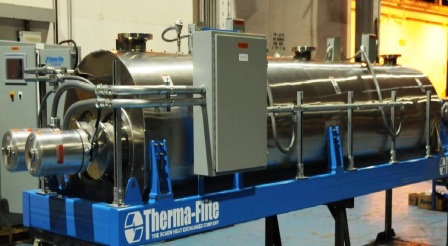
The “Electric-Scru” Processor is an efficient way to indirectly thermally process. Unique to the “Electric-Scru” Processor is its patented use of electric heating element within the rotor and housing which generate process temperatures over 1000°F without the excessive volume of off-gases associated with direct-fired technologies. For safety and portability the “Electric-Scru” Processor is fully insulated and can be skid mounted to facilitate on-site remediation. Depending on the application, the “Electric-Scru” Processor is designed with single, double or quadruple rotors. 12” to 24” in diameter and can be supplied with purge fitting for injection of inert gas into the process chamber.
Electrical heating elements contained within the hollow core of the screws are operated to heat the screws evenly at a controlled rate. Thermocouples are installed at the discharge end of the processor, which measures the material temperatures at the specified location. The equipment is designed airtight with nozzles for possible injection of an inert gas such as nitrogen to limit the oxygen content.
The housing is totally insulated for minimal heat loss. An adequate number of vapor ports are installed in order to collect the off-gas emissions generated during system operation.
A hydraulic motor is installed at the feed end, drives the screws at a controlled rate. The motor is designed to have an adequate torque capacity capable of starting the screws even when it is loaded with material.
The material of construction exposed to heat and product is generally 304 stainless steel. The screw flights are generally equipped with 1/8” thick hardface overlay to minimize wear on the flights.
^ TopOil Side Closed Loop Condenser/Scrubber
A high efficiency, direct contact, multi stage Venturi type condenser, constructed of corrosive resistant materials, followed by a packing section scrubber to remove airborne particulate. The scrubber is very effective at condensing hydrocarbon vapors and removing particulate, odors and fumes. The design of the scrubber allows for collapsing of the vapors and removal of particulate by impacting the gas stream with a high velocity spray of scrubbing/condensing liquid. After contacting the gas the scrubbing/condensing liquid and the entrained condensate is distributed through packing material then enters the lower chamber of the condenser. Condensate will then be pumped through a filter and cooled in a heat exchanger for reuse as the condensing medium. The heat exchanger cooling water side with need to be cooled via a cooling tower, cooling water pond, or other such method so as to provide cooled water to the heat exchanger.
^ TopCooling screw
The water-cooled screw rotor and jacketed housing combine to cool the treated material after Thermal Desorption Unit for safe handling.
^ TopPLC
Allen Bradley Compact Logix programmable controller with touch panel HMI display is provided complete with internal timers to control the time/temperature regimes and machine functions.